 Haushelden
 Deutsch
 Українська
 Español
 Polski
 Türkçe
 Svenska
 Nederlands
1
Recognise the skill
The child discovers what it already achieves in a digital situation: planning, practising, cooperating, solving problems or dealing with setbacks.
Experience it digitally. Recognise the connection. Carry the skill forward.
Digital experiences aren’t a side note – they’re a training ground for life.
Guiding principle of Digital-Integrative Transfer Pedagogy
Children plan in games, solve complex problems, work in a team and keep at it even after setbacks. These skills are real. But they don’t automatically get used in learning, at home or in living alongside others.
Digital-Integrative Transfer Pedagogy helps children aged 6 to 12 understand their digital experiences and develop skills from them for their whole life.
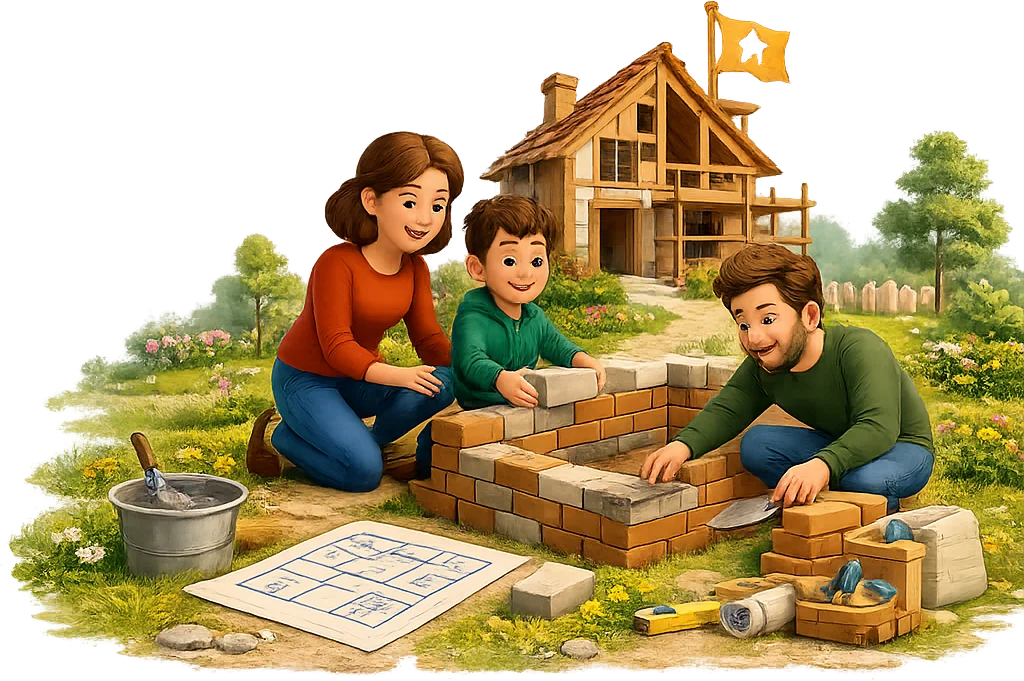
Digital and non-digital experiences aren’t opposites. Both are part of children’s world.
In digital environments, children can develop creativity, strategic thinking, cooperation, persistence and a sense of their own effectiveness. What matters pedagogically, then, isn’t dismissing digital experiences, but working out their meaning together with the child:
What can you already do there – and where else might that skill help you?
That’s how a gaming experience becomes a consciously available skill.
Children shouldn’t just get tasks done or follow rules. They should increasingly be able to understand, plan and decide for themselves. Digital-Integrative Transfer Pedagogy fosters, in particular:
“I can make a difference.”
“What I can do here helps me elsewhere, too.”
“I can start, keep at it and stop.”
“What I do matters for me and for others.”
“I recognise what motivates and influences me.”
Outside motivation can make it easier to get started. It is gradually reduced as the child develops more orientation and independence.
For skills to become transferable, children go through five steps:
The child discovers what it already achieves in a digital situation: planning, practising, cooperating, solving problems or dealing with setbacks.
Together, you work out where the same skill might be useful outside that situation.
The child applies the skill in learning, at home or in living alongside others.
Progress and effect become concretely noticeable: What worked? What got easier? What can the child be proud of?
Reminders, rewards and guidance are gradually withdrawn. The child increasingly takes over itself.
Many digital products are designed to hold attention for as long as possible. Variable rewards, daily streaks, endless content, social obligations or artificial time pressure can make it especially hard for children to stop on their own terms.
The educational answer to this can lie neither in dismissing digital media wholesale nor in screen-time bans alone. Children need to learn, step by step:
The goal is regulatory media literacy: children become increasingly able to act on their own terms even in highly attention-holding environments.
Responsibility isn’t simply handed to the child in the process. Age-appropriate limits and safeguards remain necessary. They should protect the child without creating constant surveillance, pressure or recurring power struggles.
Digital media show especially clearly how strongly visible progress, immediate feedback, reachable goals and self-chosen challenges can motivate.
Digital-Integrative Transfer Pedagogy carries these principles over into other areas of life. In doing so, it distinguishes between:
Rewards are therefore not a permanent trade. They can help set an action in motion, but shouldn’t become the only reason for it. As competence grows, they’re replaced by the experience:
I can do this. I know why it matters. I increasingly choose to do it myself.
Many educational approaches assume that parents will permanently maintain a supportive environment, consistently enforce rules, remind about tasks and reliably manage conflicts.
Under a heavy mental load, that capacity is often simply missing – for example in single-parent families, or when illness, disability or caregiving already strain everyday life.
Digital-Integrative Transfer Pedagogy takes this reality into account. Educational support should:
The concept doesn’t treat family overload as a lack of follow-through. It treats it as a condition that has to be taken into account when designing educational support.
Children can take on responsibility in everyday family life and, through it, experience belonging and their own effectiveness. But they must not become responsible for organising the family or for the emotional stability of the adults.
That holds especially when children are already under psychological strain from conflict, illness or an overloaded household. That’s why the concept draws a clear line between:
… that strengthens the child.
… that overburdens children with adults’ tasks or responsibilities.
The child should experience:
“My contribution counts” – not: “The family doesn’t work without me.”
Digital-Integrative Transfer Pedagogy brings together insights from several educational and psychological fields:
The concept doesn’t see itself as a finished therapeutic method. It’s an educational approach whose concrete implementations need testable goals, safeguards and room to keep developing.
Haushelden carries the principles of Digital-Integrative Transfer Pedagogy over into everyday family life.
The app makes tasks visible, offers manageable challenges and gives children immediate feedback. Digital motivation mechanics aren’t simply copied, but placed in an educational context: they should make it easier to get started, support the transfer, and matter less and less as independence grows.
Haushelden is not, then, the educational concept itself, but its first practical implementation.
Digital worlds don’t have to be played off against the rest of life. What matters is whether children learn to carry the skills they develop there forward consciously, self-directedly and responsibly.
Digital experience becomes recognised skill.
Recognised skill becomes application.
Application becomes independence.
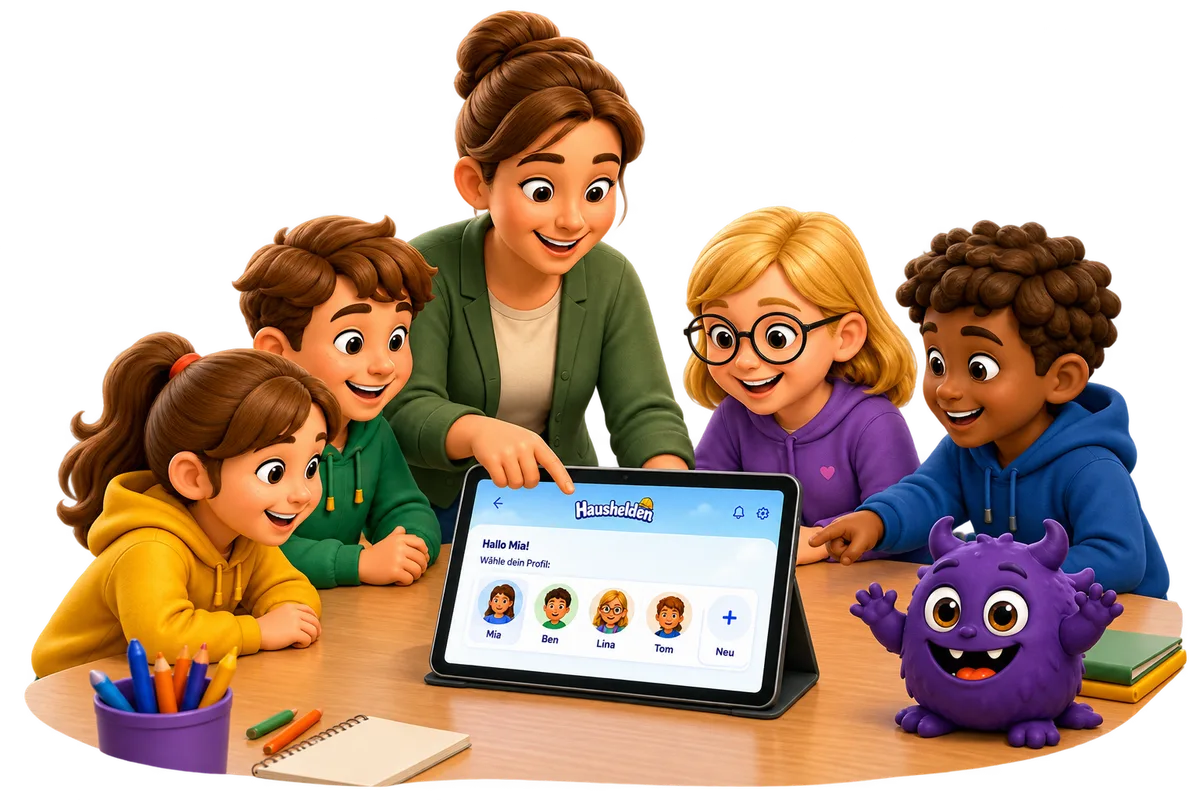
What works at home works in a group as well: routines that become visible, and responsibility you take on rather than get handed.
There’s a dedicated account for settings. One device is enough for the whole group – each child signs in with a PIN or a word of their own.

Haushelden connects everyday family life with a simple learning experience that makes children strong – today and in their future.
Experience the educational concept in Haushelden →
Haushelden is no substitute for educational guidance. The app gives families a playful structure in which important behaviours can be practised regularly.